
by Thomas Carey
(Highlights from a Substack post by Stephen Mintz)
Stephen Mintz is a Professor of History in the University of Texas at Austin, where he also served as Director of the UT system-wide Institute for Transformational Learning. Steve is also a prolific online author, first in his Psychology Today column “The Prime of Life: A history of modern adulthood” and his Inside Higher Ed column “Higher Ed Gamma”, and now on his Substack site. He is also the author and editor of 15 books on topics ranging from slavery and Mexican American history to the history of film and of reform movements, and has won awards as an innovative teacher of History.
The title of this post is borrowed from Steve’s Substack post on Dec 24th (we know: some of you were still busy wrapping presents) was particularly relevant for our work with faculty members in the Humanities and Social Sciences and our “business case” for their students as potential contributors of distinctive value in workplace innovation teams. Here is Steve’s opening statement:
The Humanities have become higher education’s punching bag and lightning rod. In public debate, they function as shorthand for everything many people believe has gone wrong with the modern university: impractical majors, low standards, weak career preparation, and political uniformity.
General education courses are dismissed as hoops to jump through. Majors are caricatured as indulgences for the privileged. Graduates are assumed to be unprepared for work. Faculty are accused—often unfairly, sometimes not—of confusing teaching with advocacy and scholarship with politics.
Whether or not these judgments are accurate in any given case is almost beside the point. Taken together, they now shape the public meaning of the university itself.
That is precisely why the humanities are not an embarrassment to be defended, but the clearest case study for how higher education might repair its relationship with the world beyond the campus.
If humanities departments can demonstrate concrete value—not just assert it abstractly—they can model what restoration of trust looks like across higher education. And the surprising truth is this: the work humanities graduates are uniquely suited to do is exploding.
The problem is not relevance. It is that humanities departments do not understand the emerging world of work well enough to prepare students for it.
Steve continues with sections on “Why the Humanities Are Losing the Argument About Work” and “A Labor Market the Humanities Barely Recognize” where “one in five Americans now holds a job that did not exist in 2000. Many of these roles—knowledge architect, conversation designer, orchestration engineer—are so new that even the people doing them struggle to describe what they do”.
He then goes on to highlight the “The AI Revolution – Where Humanists Are Already Essential” as an example work domain in which the distinctive ways of knowing developed in Humanities programs can contribute distinctive value in the workplace. Here are some example section headings reflecting distinctive Humanities disciplines and how they can add value to AI application:
Pholosophy and AI: The Invisible Architecture
Literature and AI: Narrative Understanding
History and AI: Pattern Without Context
Linguistics and AI: Language Beyond Statistics
The general principles about where and how Humanities students could add distinctive value were very resonant with our own “business case” arguments. In addition, Steve’s illustrations struck a chord with some of our past work with specific disciplines.

In a past post in this blog, a teacher of English Literature and one of her students discussed the notion of Narrative Understanding as applied in inclusive workplace innovation projects. That discussion included a sample from our tongue-in-cheek collectible cards on Heroes of the Humanities.
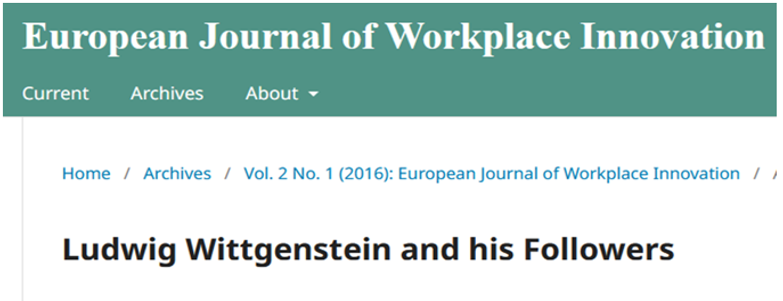
In a recent webinar, we shared related examples from Philosophy with Liberal Arts faculty, including a research article which “connects key ideas and themes from the work of philosopher Ludwig Wittgenstein (and his followers) with current concerns regarding Workplace Innovation”, in the flagship Journal of European Journal of Workplace Innovation.
Steve expands further on this notion of Narrative Understanding as applied in the workplace, with section headings on
· The Documentary Revolution: Visual Storytelling at Scale
· Streaming Platforms and Narrative at Scale
· Game Narrative Design: Interactive Storytelling
· Science Communication: Translating Complexity
· Platform Work: Content Strategy and Information Architecture
Steve’s post continues with illustrations from Healthcare – Beyond Administration and Bioethics and from other technical fields where Technical Fields – Where Humanistic Intelligence Does the Hidden Work. The concluding sessions offer specific advice on What Humanities Programs Need to Teach and on The Choices Ahead for Humanities programs in preparing their graduates to leverage distinctive ways of thinking and knowing to create distinctive value.
One choice, of course, is to collaborate with our growing collaboration of faculty members helping their students to develop, demonstrate and document that capability within innovation activities in their current and future workplaces. Thanks, Steve, for your additional examples of emerging work domains and specific potential value contributions.
(You can read Steve’s whole post for yourself here. You might also be interested in the reflections by Rob Danisch in this blog about how the distinctive discipline expertise of his Communications Arts students can contribute distinctive value in workplace innovation projects. And keep an eye out for an upcoming post by Theatre and Performance faculty member Felix Nobis about how that disciplinary preparation provides students with ways of thinking and knowing of distinctive value in workplace innovation teams.)