
In a previous post in this series, we highlighted several of the ongoing EU-wide research projects contributing to the Industry 5.0 vision, supported by the EU Horizon Europe research program. In this post we will add summaries of additional EU research projects addressing similar themes, including those from another EU research programs.
Across all these projects, the research insights and exemplary practices emerging are showing that achieving the Green and Digital Transformations in requires additional parallel investment in new organizational forms. One key organizational change is empowering the workforce with capability for workplace innovation and human-centric work design (which includes capability at both employer and employee levels).
BridgeSMEs:
The program goal is to “boost resilience and sustainability in five industrial ecosystems through adoption and deployment of advanced technologies among SMEs”. The five industrial ecosystems are Cultural & Creative Industries; Mobility, Transport and Automotive; Electronics; Aerospace & Defence.
The operating plan is a blueprint to support collaborations across two types of SMEs:
Tech-Savvy companies: These innovative SMEs aim to collaborate with other businesses to address technological gaps and accelerate transition towards digitalisation and sustainability.
Pilot Companies: These SMEs seek to improve their production processes and adopt advanced technologies through collaboration with innovative companies. Their goal is to enhance resilience, competitiveness, and alignment with Industry 5.0 principles
The SMEs involved come from multiple EU countries: Austria, Czech Republic, Grance, Greece, Hungary, Italy, Poland, Portugal, Spain, Tűrkiye and the UK.
One of the major approaches to support collaborations has been sector-specific Hackathons. (A Hackathon is “an intensive, time-limited event where participants work together to develop creative solutions for specific challenges. Originally focused on software development, hackathons have become a key tool for driving digital innovation across various industries.” Hack2BRIDGE sessions are “ideation competitions within the BRIDGESMEs project. They bring together pilot and tech-savvy SMEs and startups to spark collaboration and drive digital transformation. Participants will develop and pitch business ideas tailored to real industry challenges, fostering strategic partnerships and strengthening their local innovation ecosystems.”
Broadvoice:
The focus of the Broadvoice project is “investigating and fostering the role of trade unions and worker representatives in stimulating, informing and sustaining workplace innovation, leading to positive outcomes for employees and businesses alike”.
In addition to research institutions and affiliated foundations, the partners in Broadvoice include a wide range of EU labour associations and trade unions:
EU-wide: the European Trade Union confederation and the European Trade Union Institute
Country-wide associations: Bulgaria (Confederation of Labour Podkrepa and the Union for Private Economic Enterprise), Ireland (IDEAS institute), Netherlands (AWVN and the Federation of Dutch Trade Unions), Slovenia (Association of Employers and Confederation of Trade Unions), Sweden (Swedish Trade Union Confederation)
Sector-specific: Water and Sewerage Operators in Bulgaria, Metalworking in Italy.
In addition to a report summarizing lessons learned across the EU projects – Direct worker participation and industrial relations in workplace innovation: comparative perspectives across EU countries – there are national reports and case stories from each country.
Forging: “Industry - Academy Forum to Uncover the Potential of Emerging Technologies”
The Forging Project concluded in September 2025. However, a team of Forging Ambassadors is carrying on the work, and maintains an active LinkedIn site to support use of research insights and exemplary practices from the project and invite collaboration in ongoing activities and events.
What do we mean by human-centricity?
Human-centricity is a multidimensional framework that places human needs, characteristics, motivation, and experiences at the centre of design, development, and implementation of technological solutions and organizational practices that not only meet functional requirements, but also enhance human well, being, capabilities, skills, and working conditions.
- European Commission (2024) ERA - Industrial Technologies Roadmap on Human -Centric Research and Innovation for the manufacturing sector.
The Forging project is an excellent demonstration of the distinctive contributions that the ways of thinking and knowing developed in the Humanities and Social Sciences can bring to innovation projects. Defining and applying Industry 5.0 concepts like “human-centric” will require a multidisciplinary approach and new ways to achieve innovative transdisciplinary outcomes.
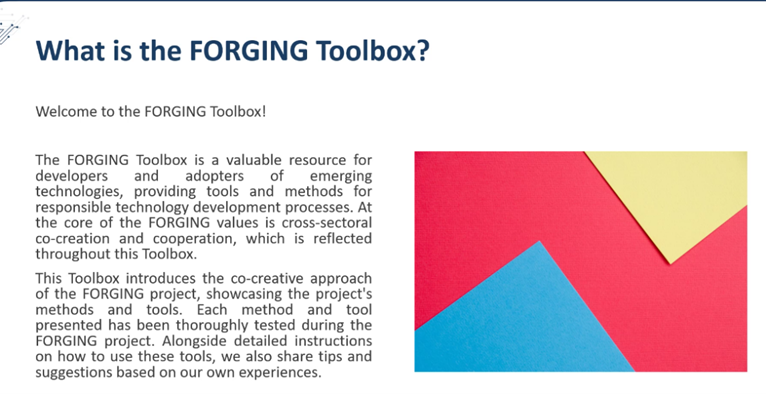
The Forging project also created practical tools to embed the exemplary practices and research insights from the project into organizational use.
Personal high point: filling in the Forging profile and seeing Philosophy as one of the options for “Home Discipline”.
SKILLS4EII: Skills Alliance for the Green, Digital and Social Transformation of Energy Intensive Industries
“Skills4EII is set to transform energy‐intensive industries by developing a comprehensive skills framework that bridges both sector‐specific and cross‐sector needs. Drawing on past initiatives and an advanced online training hub, the project supports the green, digital and social transition, equipping the workforce with future‐capable skills…
An essential part of SKILLS4EII is to identify and adjust additional skills gaps, both cross-sectoral and sector-specific, within national and regional skills and training ecosystems. Skills4EII will create a common framework integrating specificities of all industries to continuously and proactively adjust the skills demands of the energy intensive industries (including further process industries). The Skills4EII project is aligned with the Large Scale Partnership Energy Intensive Industries (LSP EII) under the Pact for Skills (one of the flagship actions of the European Skills Agenda)”.
A key part of the SKILLS4EII plan is the Skills Foresight project to map future skill and roles, with Irish company InnoGlobal. The results to date include 527 occupational profiles (176 Legacy Roles requiring Upskilling and 351 new or evolving Transformed Roles) and 22 Game Changer Roles.
Sure5.0: Supporting SUstainability & REsilience in European SMEs.

The main target audiences of SURE5.0 are SMEs working in the Civil transportation and Electronics ecosystems (Mobility, Transport & Automotive; Aerospace & Defence; Electronics),
The SURE5.0 Project formally concluded in May 2025. However, the Community of Practice formed in the project is carrying on the work, and maintains an active LinkedIn site to support use of research insights and exemplary practices from the SURE5.0 project and invite collaboration in ongoing activities and events.
SURE5.0 produced numerous tools for SMEs seeking to develop their capability for Industry 5.0, such as the Industry 5.0 Transition Guide: Resources and Tools for Your Growth. SURE5.0 also offered a series of Acceleration Programs to connect SMEs with leading-edge support and resources, as documented in a series of video case stories of SMEs successfully moving forward on Industry 5.0 goals and practices.
CoVE Program Projects:
Two other EU projects, funded by the Erasmus+ program to support transnational tertiary education as part of the CoVE program also have close links to the Industry 5.0 research. ”Centres of Vocational Excellence (CoVEs) are pillars of excellent vocational education in Europe. CoVEs are formed by networks of partners that develop local ‘skills ecosystems’ to provide high quality vocational skills to young people and adults, and contribute to regional development, innovation, industrial clusters, smart specialisation strategies and social inclusion”.
WIN4SMEs:
Enabling Centres of Vocational Excellence in Workplace Innovation across seven EU countries (Baltic Sea region).
“The focus of many SMEs still predominantly lies on technological innovations. Recognizing the potential of Workplace Innovation could shift this perspective, unlocking latent productivity and propelling SMEs towards future success.” WIN4SMEs is also the first project we have seen that specifically targets Human Resources Management professionals amongst its skill specifications.
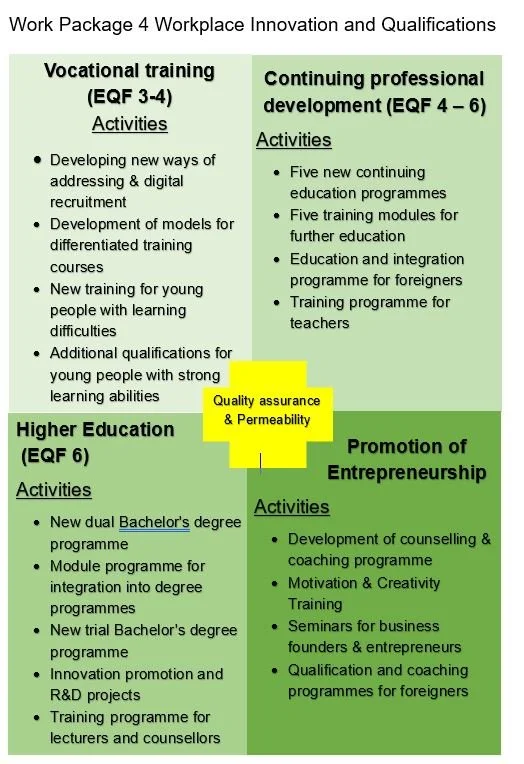
Amongst the deliverables of WIN4SMEs, Work Package 4 (shown below) relates directly to our WINCan activities in both Higher Education and Workforce Development.
Finally, the newest project in this list is INSIDE-CoVE: Empowering Sustainable Skills for Tomorrow's Construction Leadership. Launched in April 2025 by SKILLS4EII (and supported by Erasmus+), “The project aims to establish innovative CoVE networks to advance construction skills across four European countries, create a transnational collaboration network of CoVEs, equip young people and adults with necessary skills for the evolving labour market, deploy state-of-the-art infrastructure and digitalisation strategies in VET institutions, and embed environmental principles, social sustainability and inclusion.”
INSIDE-CoVE connects and leverages four national subnetworks in Germany, Greece, Ireland and Spain. In Greece, the focus is on the aluminium value chain; in Spain, digital construction; in Germany, smart buildings; and in Ireland, green buildings and the circular economy. (There are additional partners in Belgium and Cyprus.)
Given Canada's national strategy to enhance European partnerships as part of diversifying our trae partnerships, a national CoVE-like initiative in Canada has huge potential to collaborate with these EU colleagues and adapt research insights and exemplary practice to our Canadian contexts.
We also have a start on a contribution to share with EU colleagues, in the award-winning learning resources that we (Workplace Innovation Network for Canada) have developed in collaboration with partners in the EU Workplace Innovation Network, These use a case-based instructional design, making it easier to integrate case stories for specific work domains such as Construction.
Postscript: There are, of course, many additional EU projects at the national level on which we are trying to keep an eye for insights adaptable to our Canadian contexts. For example, in an upcoming post we plan to profile the Smart Skills@Scale project in the Netherlands (targeting SMEs in Advanced Manufacturing, and with an impressive team and eight-year duration).
Update to the Postscript (!): Just as we were updating this post (in Feb. 2026), yet another valuable project showed up on our radar – SONATA Horizon. For a quick overview of its relevance to the other activities listed above, check out this video from Peter Totterdill of Workplace Innovation Europe, Bridges 5.0, et al.