
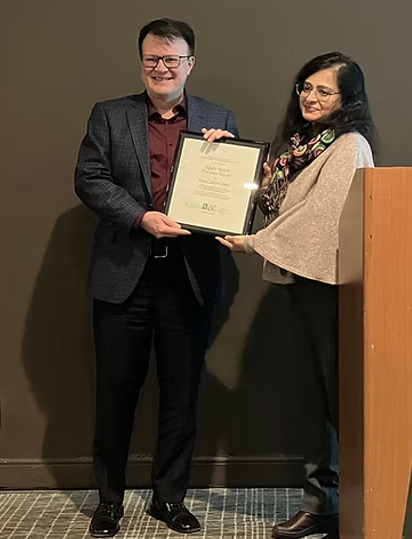



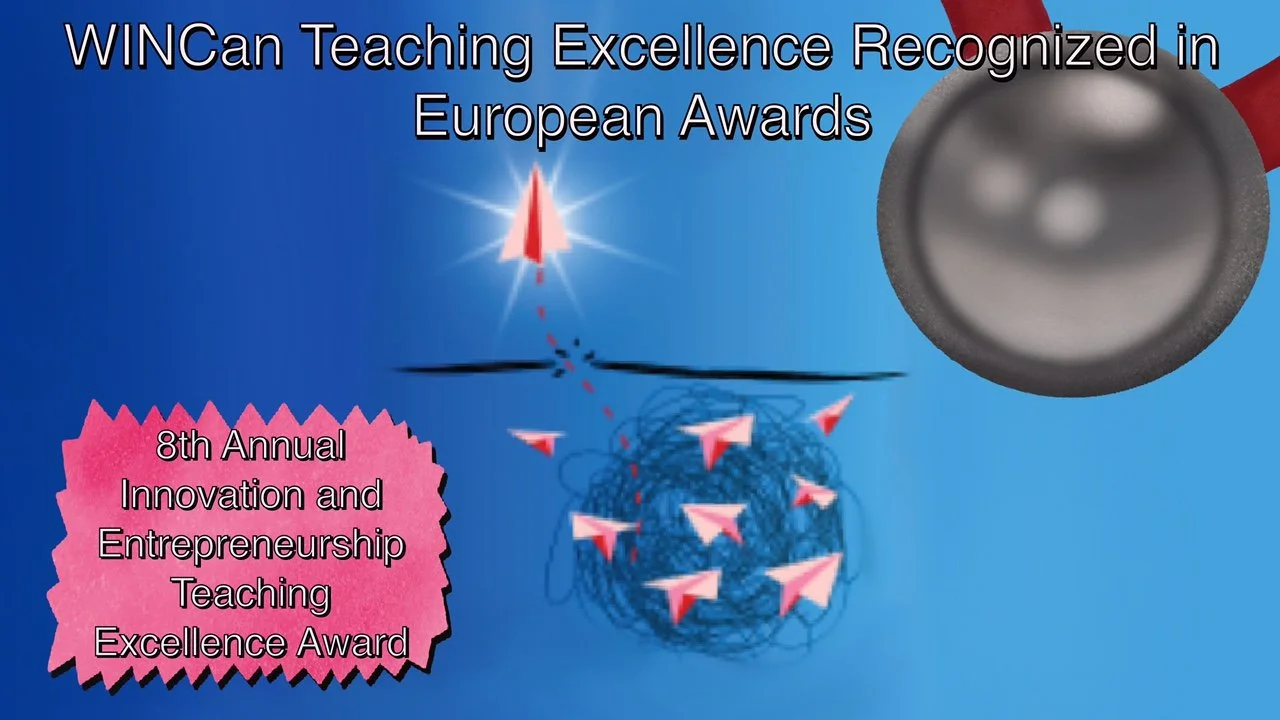
We are delighted to announce that the innovations in teaching and learning developed by our WINCan team and our academic partners in Australia and Canada have been recognized in the 2022 Innovation and Entrepreneurship Teaching Excellence award. The final stage of thisinternational competition was on September 16 th , hosted by Neapolis University in Cyprus as part of the 17 th annual European Conference on Innovation and Entrepreneurship.
What We’re Learning about Understanding Workplace Innovation at Monash Arts
In our post in this weblog last month, we highlighted our inclusion amongst the finalists for the 2022 Innovation and Entrepreneurship Teaching Excellence award in Europe. One element of this final stage was the preparation of a book chapter to be included in the finalists’ Anthology of Case Studies to be published as part of the award process.
Developing Graduate Capability in Workplace Innovation is Recognized in Europe’s Innovation and Entrepreneurship Teaching Excellence Awards
Great news: we found out this week that WINCan and two of our academic partners have been short-listed as finalists for the 2022 Innovation and Entrepreneurship Teaching Excellence Award (based in Europe – this is the 8th annual award). In September, our team presents at the final competition round in Cyprus – virtually, from our home bases in Canada and Australia.
Adapting Workplace Innovation to Advance Quality of Work in Canada (Part 2)
In this post we’ll describe the specific challenges being tackled by each of the partners who will be working with us to test adaptations of the insights in our Research Synthesis, to meet their needs and contexts (and, more generally, helping us to understand the issues and benefits for adapting European research into Canadian contexts). his both project involves both a synthesis of past research and a set of organizational innovation projects to apply, critique and extend that previous research. We’ll describe in this post the individual focal points for each of our four Field Test sites.
Adapting Workplace Innovation to Advance Quality of Work in Canada (Part I)
We’ll describe in this post our new partnership of experts in Workplace Innovation and four leading organizations who are advancing Workplace Practice and Policy (one pan-Canadian, three regional). With support from Canada’s Future Skills Centre, we will analyze and adapt the research base on Workplace Innovation for Quality of Work – mainly from Europe– to support more innovative, engaging and inclusive workplaces in Canada. We will be assisted throughout by Dr. Peter Totterdill, one of the world’s foremost experts in Workplace Innovation for Quality of Work and Founding Director of Workplace Innovation Europe.
Adaptable Learning Resources for Workplace Innovation: What Have We Learned? (part II)
In part I of this two-part series, we described the context and content of reusable course modules to introduce higher education students to Employee-Led Innovation in the Workplace, and how the modules were deployed in a course unit at a university School of Business.
In this follow-on post, we will also explore our initial methods for assessing the development of learner capability for workplace innovation, including use of a new workplace tool for assessing aspects of innovation mindsets.
Adaptable Learning Resources for Workplace Innovation: What Have We Learned? (part I)
One year ago, we began a WINCan project to explore how we could create resources, activities and experiences for adaptable teaching and learning resources which Higher Education institutions could adapt for teaching and learning for Workplace Innovation.
We were basing our project on an Instructional Design for adaptability developed in a previous Ontario-based project with six Ontario colleges and universities and six workplace partners from the corporate and public sectors. We also applied what we had learned in working with our collaborating institution in Melbourne (Australia) in co-developing their pioneering course unit on Understanding Workplace Innovation.
In this series of two posts, we will focus on what we’ve learned over the last year from adapting teaching and learning resources for Workplace Innovation in Higher Education. Our aim is to help Canadian institutions move toward the goal of “Every Graduate Can be an Innovation Enabler” with flexible resources and formats
Intrapreneurship as Workplace Innovation in Accountancy
This post presents our final proof-of-concept test of our prototype professional development Ladder of Opportunities in Workplace Innovation in the work domain of Accountancy. These tests were intended to identify how well the framework fits with what we know about workplace innovation in a specific workplace domain and to identify some of the context-specific issues to be addressed for the framework to be used productively. Previous posts looked at Job Crafting, Innovation Adaptation (including specific examples from the Audit area) and Design Innovation (with a focus on Design Thinking in Accountancy).
Design Innovation for Accountancy
This post presents the third element of our proof-of-concept test of our prototype professional development Ladder of Opportunities in Workplace Innovation through identifying suitable case stories in the work domain of Accountancy. These tests were intended to identify how well the framework fits with what we know about workplace innovation in a specific workplace domain and to identify some of the context-specific issues to be addressed for the framework to be used productively.
Workplace Innovation in Accountancy: Innovation Adaptation in Auditing
In previous posts, we outlined our prototype workplace innovation Ladder of Professional Development Opportunities and provided illustrations from the work domain of Accountancy for the first two opportunities (Job Crafting and Innovation Adaptation), along with a demonstration of how innovative developments in Accountancy practice have opened up new opportunities for employee-led Workplace Innovation by accountants.
In this post we follow up with examples from the specific Accountancy subfield of Auditing, to illustrate the dual goals of employee-led Workplace Innovation (improving organizational effectiveness and quality of work life), adaptation of innovative accounting practices from sources outside the firm, and the development of new innovator roles for accountants in Audit.
Workplace Innovation as an Example of Expanding “Ways of Knowing” in Polytechnic Education
The value of Workplace Innovation in preparing graduates for the Future of Work has been explored from different angles in our WINCan work and in this blog. Here we consider the implications of developing “every graduate” innovation capability on prevailing ‘ways of knowing’ in higher education. Our focus will be on polytechnic education and institutions, and how in that context including workplace innovation capability as a graduate outcome prompts us to:
expand our conception of knowledge as driven solely by technology, and to
discover new ways of working beyond traditional vocational and professional domains.
Case Stories of Job Crafting in Accountancy
Since Accountancy is a highly-regulated profession many people – including some accountants and higher education students in accountancy – have the impression that Job Crafting is a limited option within the profession. Our crafting examples here, from Jennifer and Candice, demonstrate some of the many ways that Job Crafting is commonly utilized by accountants… and how it will be needed even more as some of the changes in the profession outlined in our previous post come to fruition.
Workplace Innovation in Accountancy: Job Crafting and Innovation Adaptation
In this post we describe specific examples for workplace innovation in the Accountancy work domain for the first two elements of our prototype framework: Job Crafting and Innovation Adaptation. A future post will add examples for Design Innovation and Intrepreneurship.
Why Accountancy as a Test Case for the Workplace Innovation Ladder of Opportunities?
In a previous post, we outlined our prototype framework for a Ladder of Opportunities for professional development in for individual capability to engage with innovation in the workplace. We have been piloting, evaluating and refining this framework in two ways:
Proof-of-concept test cases in specific work domains, to identify how well the framework fits with what we know about workplace innovation in that domain and to identify the context-specific issues to be addressed for its productive use in domain-specific professional development for workplace innovation.
Ongoing experiments to apply the framework in higher education learning experiences, to develop capability in workplace innovation across a range of potential work domains
In this post, we describe our use of the Accountancy work domain as an initial proof-of-concept test case for the first of these evaluations.
“Every Employee” Engagement with Workplace Innovation: A Professional Development Ladder
We describe in this post a way to bridge the perceived gap between the innovation capabilities and experiences across the workplace: a Ladder of Opportunities to progressively build skills, knowledge and mindsets for innovation, allowing employees to choose their own level of engagement a any given time. We also outline results from initial Proof-of-Concept tests and work underway with workplace partners.
Looking Outside Higher Ed for Insights on Sustaining Strategic Innovation
The U.S. daily newsletter Inside Higher Ed recently highlighted our WINCan project to explore how we can effectively adapt insights on organizational innovation from the corporate sector to Higher Education. Our guest post in IHE’s Higher Ed Gamma column was entitled Looking Outside Academia for Insights on Sustaining Strategic Innovation.
More Than Innovation: WINCan’s Contributions to Scholarly Research
Case-Swapping to Adapt Resources on Workplace Innovation Across Contexts
In one of our previous WINCan projects, a collaboration between workplace and academic partners to share and adapt learning resources on Workplace Innovation, we developed a case-based instructional design model intended to foster resource sharing and adaptability. In a new project launching this week, we’ll be testing those ideas, by creating new online learning resources to incorporate Workplace Innovation concepts and activities into a course at an Ontario higher education institution…while in parallel working with another higher education institution (in Alberta) and an Ontario workplace partner on pilot studies to assess how those resources could be adapted for their specific contexts.
Prototyping Cycles and Minimum Viable Products in Higher Education
In Part I of this blog post, we explored how one Research Insight on Strategic Innovation from research in the corporate research – distinguishing Discovery, Incubation and Acceleration activities and the corresponding organizational competencies – plays out differently in the context of Teaching and Learning in Higher Education. In developing our two Strategic Innovation scenarios for higher education institutions, another major difference we noted was the challenge of rapid prototyping as an Incubation activity.
How do Competencies in Strategic Innovation Differ across Sectors?
In our previous WiNCan posts on the Sustaining Strategic Innovation in Higher Education project, we described some of the insights from a series of research studies on strategic innovation in the corporate sector and our use of scenario prototypes to experiment with adaptation of those insights for strategic innovation in Higher Education teaching and learning.